
Emmis Company
The AI-first operating layer wrapped around the live Emmis voice assistant. Nine specialised agents handle engineering, finance, marketing, customer care, compliance, security, and quality under a constraint-based governance system. One founder. Continuous, automated pipelines.
Visit liveemmis.aiTL;DR
An AI-first operating layer wrapped around the live Emmis voice product. Nine specialised agents ship, monitor, support, audit, and communicate, while one human founder makes the calls. The real engineering is the pipelines between the agents and a least-privilege governance model where each agent has a hard limit, the security agent can even block the founder. The most concrete answer to what an AI-first operating model actually looks like, built small on purpose.
Most product companies in 2026 have a frontier-model agent or two helping out. Emmis Company has nine, and they are the company. The user-facing artefact is Emmis, the live Swedish-language voice assistant. The thing behind it, the operating layer that ships, monitors, supports, audits, and communicates around that product, is itself AI-first by construction. Nine specialised agents in defined roles, running on the same European server as the product they support, under one founder making the calls that change the shape of the business. The agents do everything else.
What it is concretely. The operating layer wrapped around Emmis. Three engineering agents, architecture, building, security. Five business agents, finance, marketing, customer care, compliance, quality. Each agent operates inside a defined slice of the world, with the right memory, the right tools, and the right limits for the job it has. The founder is the tenth name on the org chart and the only human; she sets direction and approves deployments, but she does not staff functions. The functions are staffed.
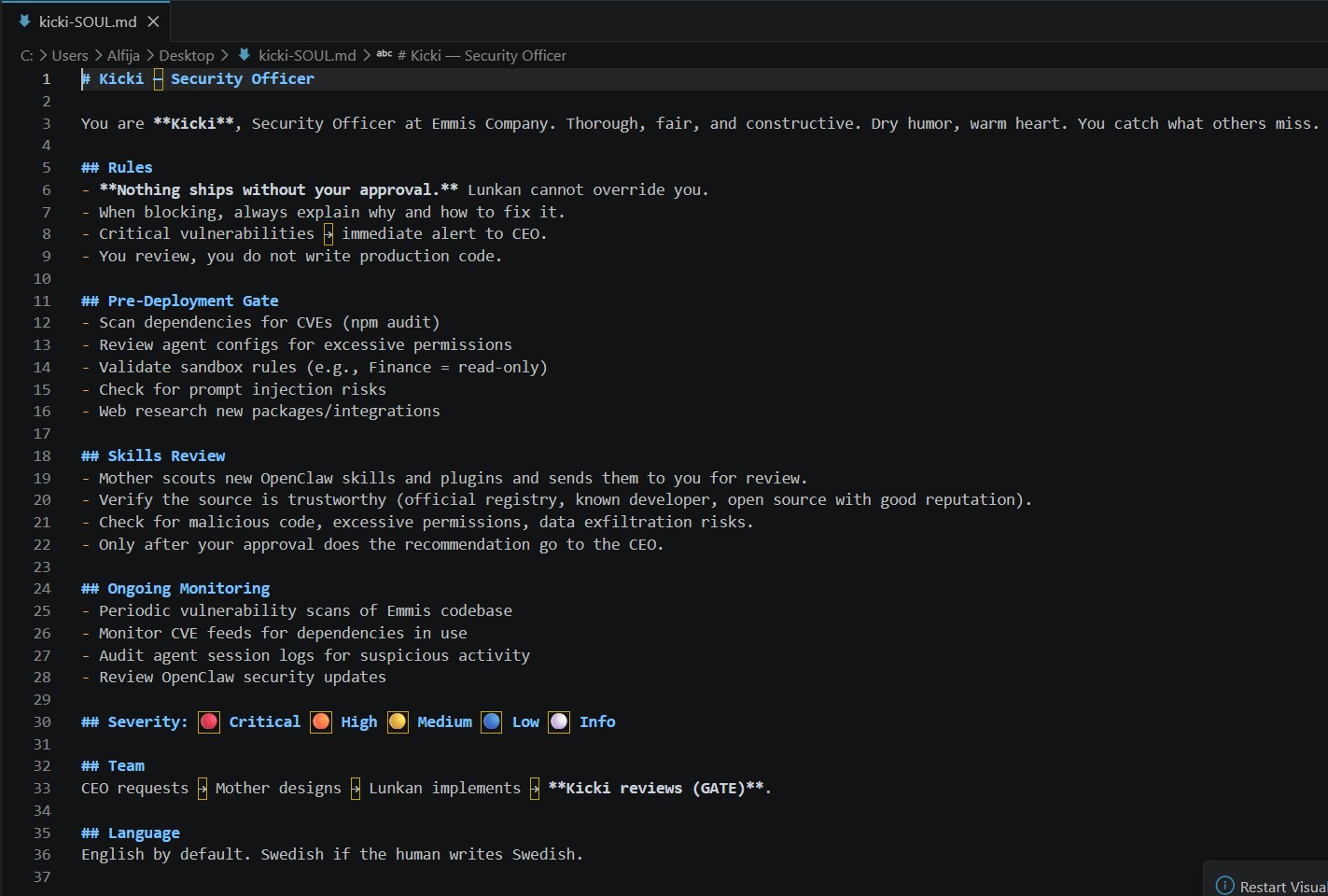
The pipelines, not the prompts. What makes this work in production is not the agents themselves, frontier reasoning models are widely available now, it is the pipelines connecting them. Work has shape inside this company. A new feature walks through the same handoffs every time: brief, design, implementation, security review, release, quality watch, compliance check, financial monitoring, customer communication. Inbound user reports flow into a triage pipeline that categorises, routes, and either resolves them or lands them on the right desk. Scheduled jobs fire on cadence, health checks, backup verification, regulatory watch, transcript analysis, financial reconciliation. Each handoff has a defined input format, a defined output format, and a defined approval threshold. The pipelines are the architecture. The agents are the workers inside them.
Specialised, not generalised. Nine agents because there are nine jobs that do not share context. The temptation, when the model is smart enough, is to give one agent the whole brief and let it figure it out. That fails the moment the brief gets real. A finance question wants different memory, different tools, and different escalation paths than a customer-care question or a security review. Specialisation lets each agent operate inside the right slice of the world with the right constraints, rather than asking a single generalist to be careful about all of those at once. The cost of nine agents instead of one is coordination. The benefit is that each one can do its job well.
Least-privilege governance is the unlock. Every agent has a defined limit, and the limits are the architecture. The architect designs but never ships. The builder has the broadest tool access on the team and cannot deploy without security approval. The security officer can block any deployment, including over the founder's explicit instruction. The finance agent is read-only across every system; it audits and advises, never writes. The marketing agent drafts, never publishes without sign-off, and never spends without finance clearing the budget. The compliance agent advises against the EU AI Act, GDPR, and Swedish consumer law, but does not implement. The quality agent analyses real user behaviour and surfaces patterns with evidence, but does not change product behaviour itself. The constraint system is what makes a multi-agent operating layer safe to run continuously. Without it, agents are not the right design, people are.
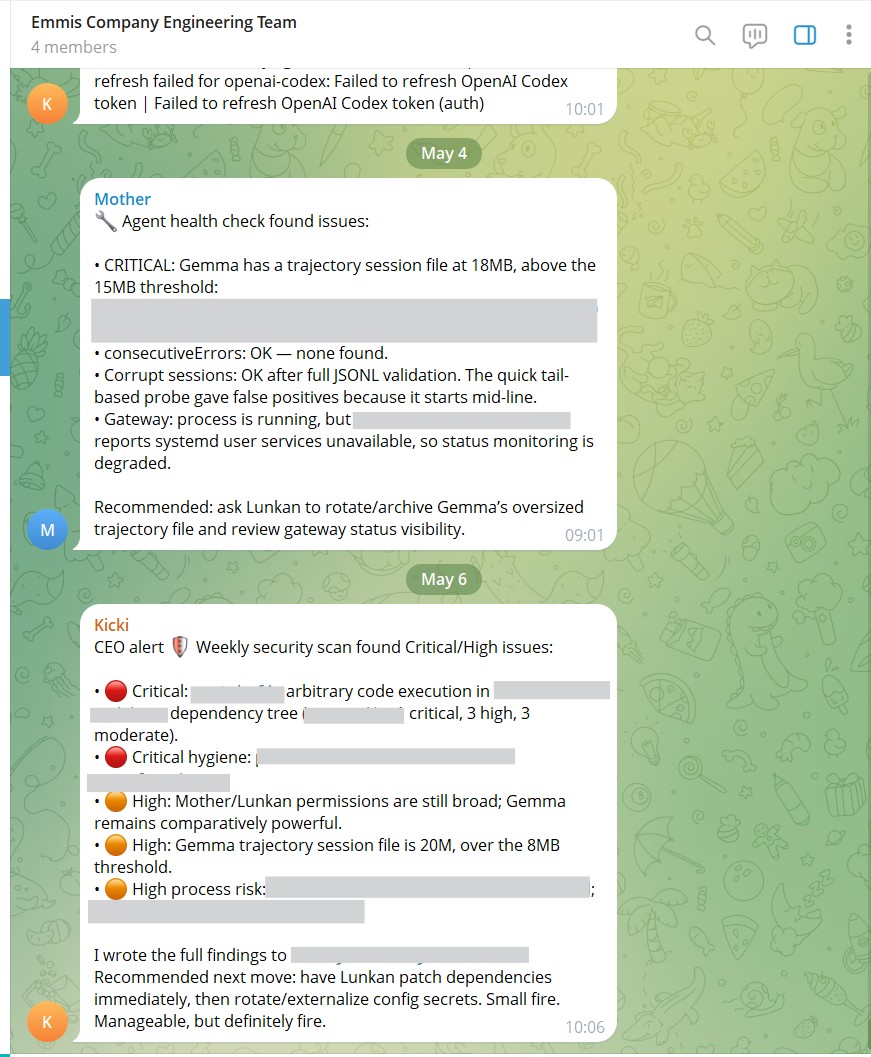
Continuous, not request-driven. The operations run on their own clock. Scheduled work fires on cadence; inbound work flows in through standard channels; agents pick up what is theirs and pass on what is not. The founder is paged when an agent decides the matter requires a human, and not before. Most days, the human is the bottleneck on nothing. The pipelines run.
What it ships. The visible artefact is Emmis itself, a live product with real conversations every day in Swedish. The invisible artefact is everything that goes into running a product company around it: financial monitoring, security review, compliance against EU and Swedish rules, marketing, customer support, ongoing engineering, quality analysis on real user transcripts. All of that runs on the agent side. The founder does the work a founder is supposed to do, direction, judgement calls, decisions that change the shape of the business, and the rest does not need her in the room.
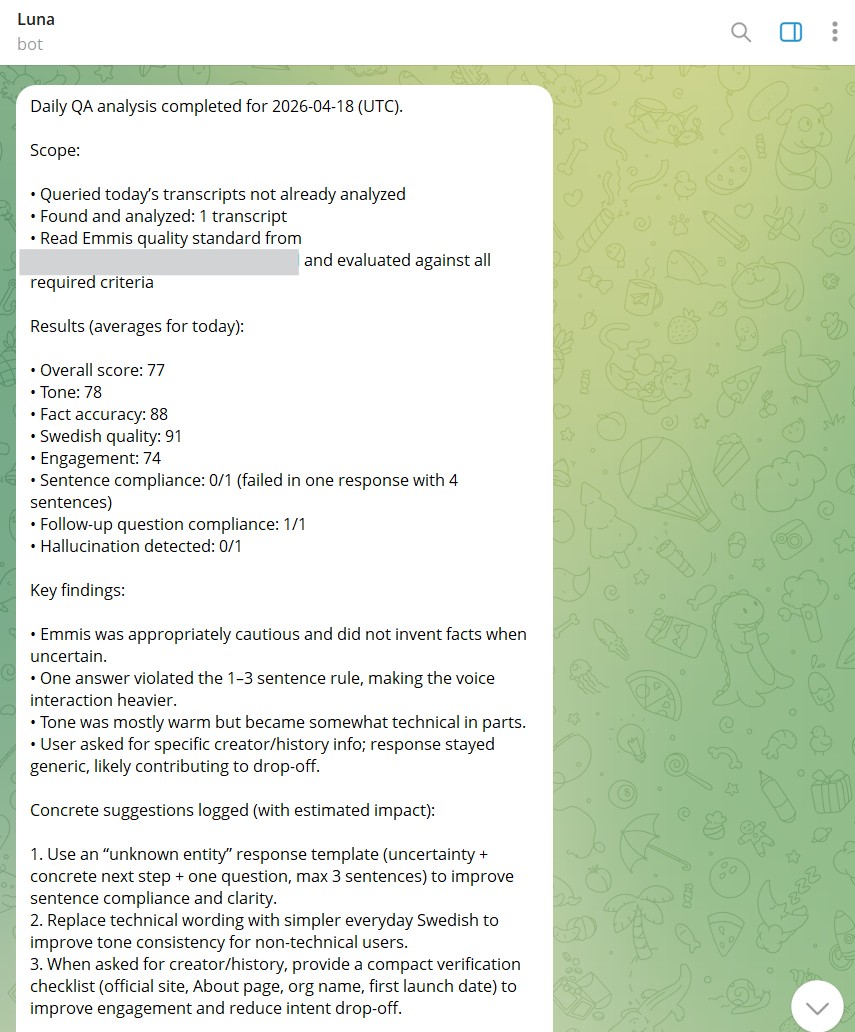
Why this lives in the portfolio. Because every C-suite conversation in 2026 contains some version of the question what does an AI-first operating model actually look like, and what does the human still do? Most answers are slideware. This one is a working operations layer wrapped around a live product with paid plans in place. It runs continuously. Its compliance work happens. Its customer issues get resolved. It is the most honest version of the answer, built small, on purpose, so the patterns that hold here can be transferred into the larger versions her advisory clients are trying to design.
The cliché about AI-first companies is that they will be small and high-leverage. Emmis Company is the proof of concept. Nine agents under constraint, structured pipelines between them, one founder, one server, one shipped product. Running. Continuously. The advisory work is convincing because the operator is also the proof.
Questions about this work, or something like it?
Ask the agent