
AlgoAlfi: Trading Robot
A fully automated trading-signal system she designed and runs against her own retail portfolio, multiple brokers, multiple timeframes, one Monday-morning routine.
TL;DR
A fully automated trading-signal system she designed and runs against her own retail portfolio across multiple brokers and timeframes. Every Monday it scans the markets, runs the strategies, computes position-sized trades, and writes them as concrete BUY/SELL tasks. Execution stays manual by design, the system removes the impulse, not the human.
The system exists because Alfija advises C-suite on AI transformation, and wanted to know, viscerally, what it costs to actually ship a piece of automation you trust with consequences. Trading her own retail account is the cleanest way to find out: real decisions every Monday, no committee to hide behind, no client to escalate to. The point of AlgoAlfi is not alpha. The point is the discipline of a system that takes the impulse out and leaves only the rules, rules she set in advance, risk caps she accepted in advance, and a routine she can follow when the market is loud.
The split. The portfolio runs across multiple brokers and asset classes, each with its own cadence. Long-horizon positions rebalance monthly; faster-horizon positions rotate weekly. The cadence is deliberate: monthly is slow enough that long-horizon positions are not over-traded; weekly is fast enough that shorter trends are not missed. The specific instruments, parameters, and allocation rules are the working IP of the system and are not published, edges that get written down get arbitraged away.
Live data, every run. Every scheduled run fetches market prices fresh, pulled from public market-data providers the moment the job fires, not from yesterday's snapshot, not from a cached database, not from a weekend export. Momentum scores, trend filters, and position-sizing maths all operate on the prices the market is showing right now. The signals that land in the dashboard on Monday morning reflect what was actually happening at the open, not what was happening last week. Stale data is the most boring way for a quantitative system to lose money, and the simplest discipline to avoid it is: refetch everything, every run, before anything else executes.
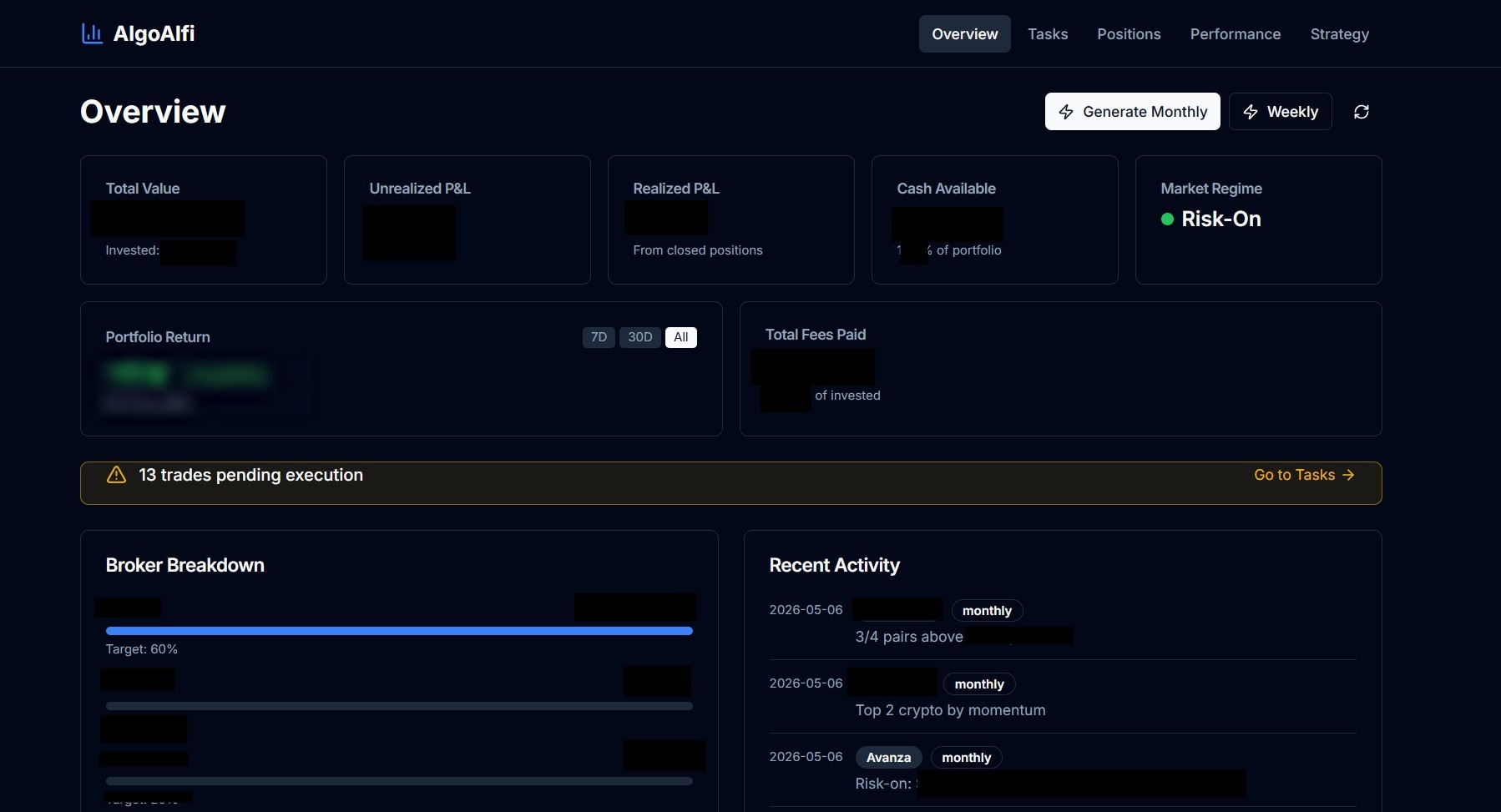
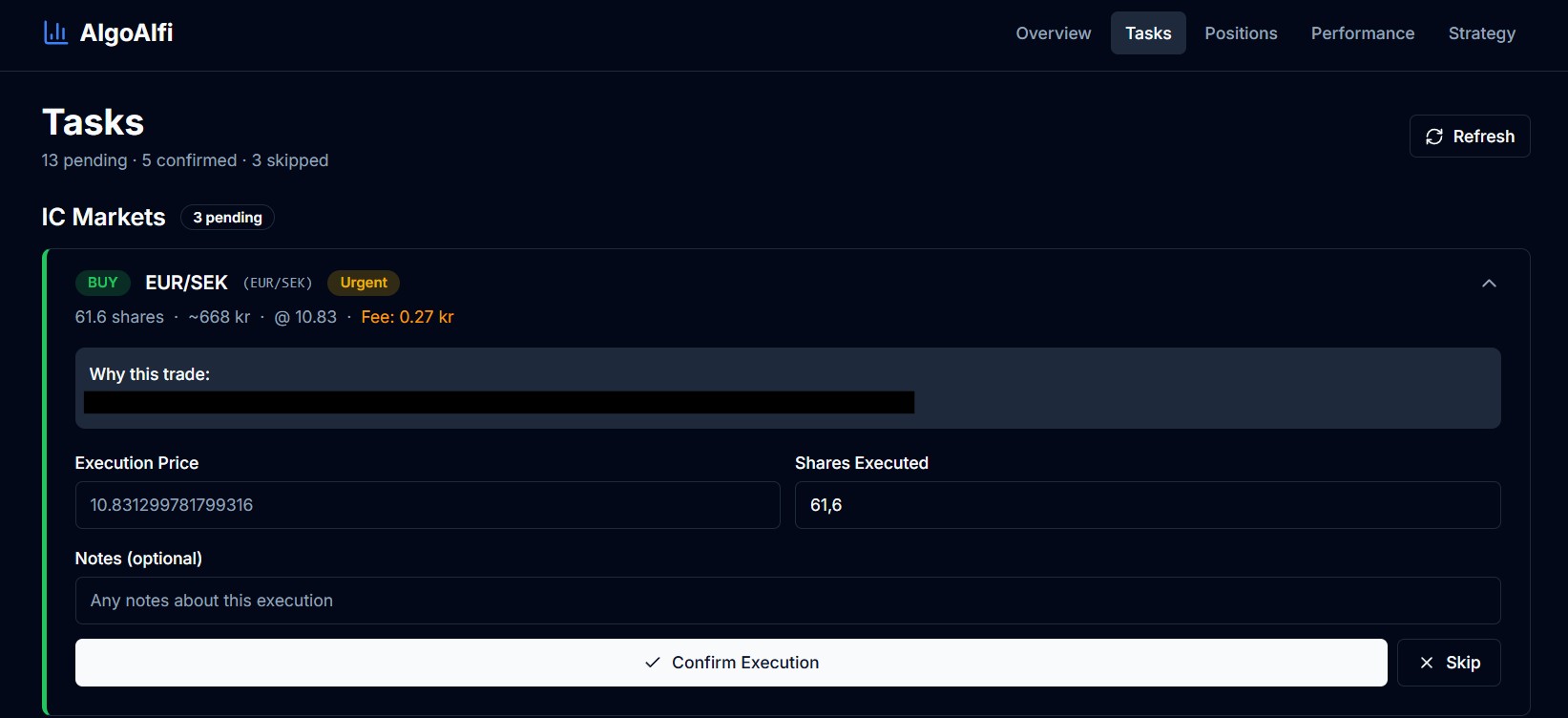
Manual execution by design. A scheduled job triggers the signal generator. The bot pulls live prices, runs the strategies, computes rebalance tasks against the current positions, writes them to a SQLite database, and sends a Telegram notification. Then a human, her, opens the dashboard, executes each trade in the broker app, and confirms the fill price back into the system. There is no broker-API integration. That is not a missing feature; it is the architectural choice. Storing broker credentials would shift the system's risk profile from "wrong signal once" to "compromised system always", and on a personal account that trade-off is not worth the convenience. The cost of that choice is a short Monday routine; the benefit is that no key on her laptop can move her money.
Risk taken in advance, not invented under pressure. The drawdown tolerance is declared up front, in writing, before any drawdown happens. Each sleeve has its own stop discipline appropriate to the asset class. Position caps prevent any single instrument from dominating its sleeve. Rebalances under a drift threshold are skipped, and small trades are dropped, to keep noise out of the broker app and the brain. None of that is improvised at the moment of action.
Why this lives in the AI portfolio and not the trading-hobby drawer. Because it is a working answer to the question CIOs ask her every week: what does it look like when an AI system takes a real decision in a real environment, and what does the human actually do? It looks like a Monday-morning dashboard with a short list of tasks on it. The human reads, executes, confirms. The system does the analysis, the ranking, the position sizing, and the recordkeeping. The split of labour is the deliverable.
What you see when you log in is a list of trades. What's underneath is a system that codifies every market view and every risk cap she would otherwise have to make up under stress.
Questions about this work, or something like it?
Ask the agent