Multi-Tenant AI Learning Platform
A multi-tenant educational platform that turns a consultancy's proprietary methodology into a live product, interactive workshops, AI analysis on every exercise, RAG-grounded gap analysis against each tenant's own documents, and a maturity self-assessment that follows individuals over time.
TL;DR
A multi-tenant platform that turns a consultancy's proprietary methodology into a live product, with interactive workshops, AI analysis on every exercise, and RAG-grounded gap analysis against each tenant's own documents. An individual maturity self-assessment follows people over time, and a facilitator control surface ties it together. Multi-tenant and multi-role from day one, serving public and private sector, in active build.
A consultancy's most valuable IP is rarely the slides. It is the facilitation pattern, the order of the questions, the language of the synthesis, the way a senior consultant in the corner takes a room of group answers and turns them into a coherent next-step picture by lunchtime. This platform puts that pattern in a product, and wraps it in the consultancy's own brand and its own protected methodology.
What it is. A multi-tenant educational platform owned by the consultancy and sold to organisations across both public and private sector. Three structured programs run on it. Interactive workshops that groups join from a single screen, work through with on-screen methodology guidance, and submit. AI analysis after every exercise. Document upload per tenant, with retrieval-augmented gap analysis against each tenant's own uploaded documents. An individual maturity self-assessment that follows people over time and rolls up into team and organisation cuts. A facilitator control surface that ties it all together. The consultancy's methodology, productized.
Brand-and-IP-protected from day 1. The consultancy's methodology is the asset. The platform was built around protecting that asset, not around exposing it as configurable templates anyone could lift. Programs, exercises, methodology scripts, AI prompt patterns, maturity rubrics, all owned by the platform, not by tenants. A tenant runs the methodology; they do not author or modify it. That separation is what makes the platform a product instead of a CMS.
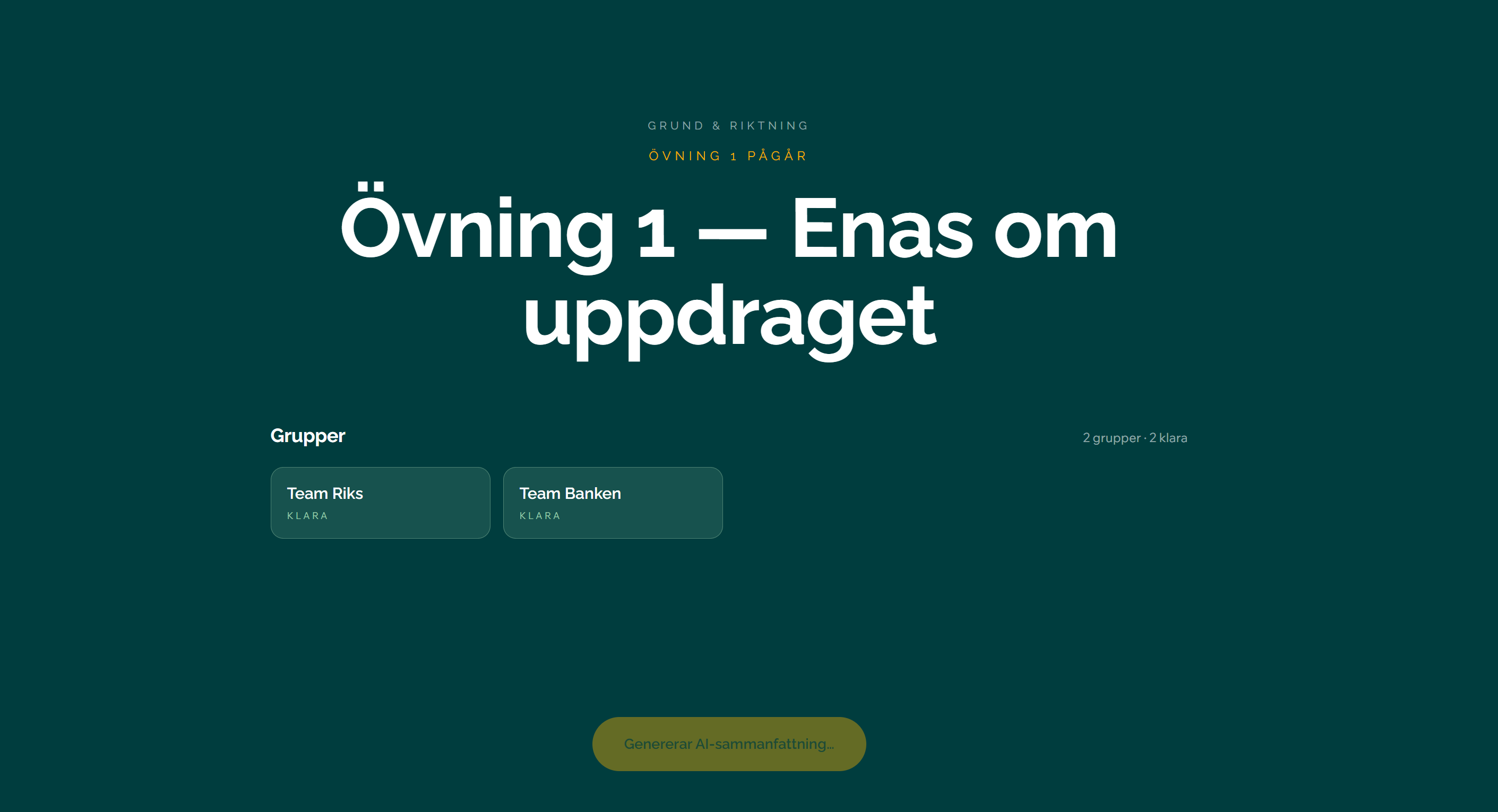
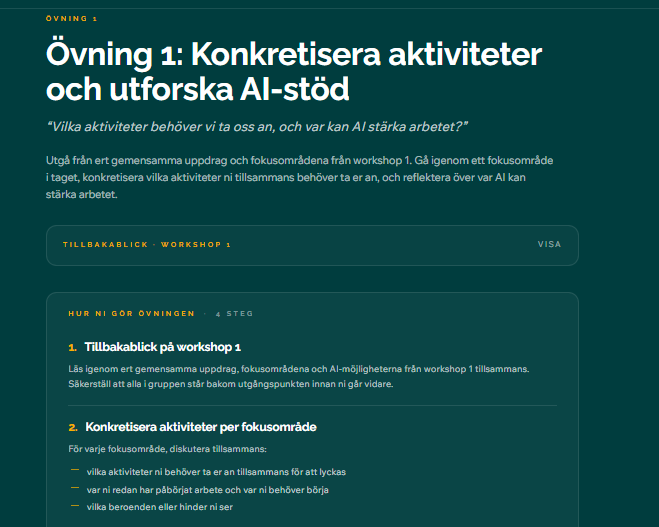
Three structured programs. Change leadership, AI-transformation, and a hybrid that combines both. Each runs as an arc of workshops in a 90-minute format. Every exercise carries its own facilitation script as data, methodology is content, not code, so a new exercise ships its own steps without a release. Methodology is data; questions are data; supporting context is data.
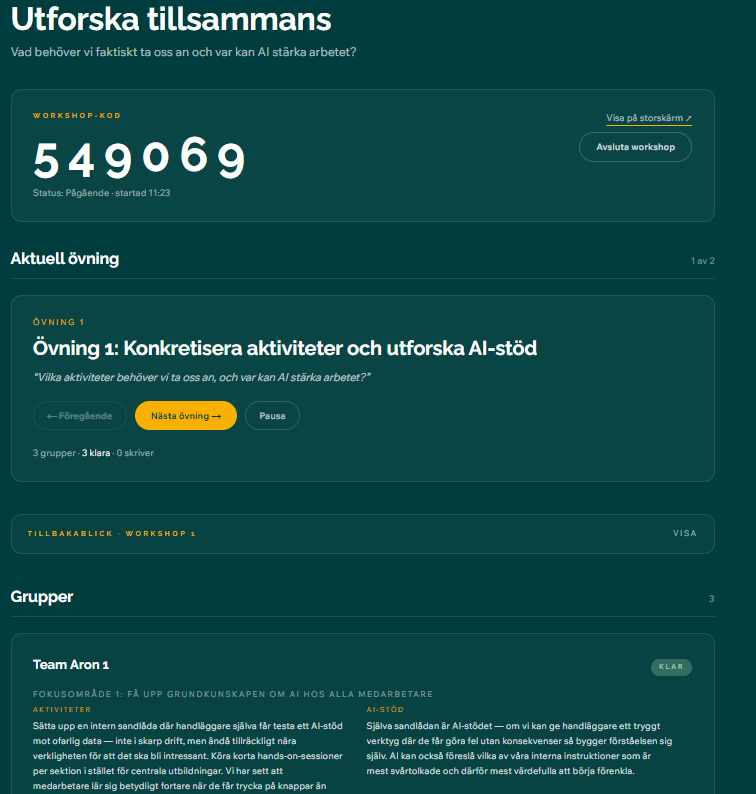
Several roles, one platform. Facilitators run sessions, advance exercises live, own the post-workshop synthesis, and have a CRM-style view of every client. Group participants join anonymously via a code, name their group, and work through the exercise on their own screen. Identified individuals take the maturity self-assessment over time. Tenant admins read past results for their organisation. Each role gets its own surface; the data model holds them all together.
AI analysis through the whole arc. At the close of each exercise the facilitator clicks Generate. The platform takes every group's answers, calls the model with a Swedish-language structured prompt, and persists a typed result, sammanfattning, named teman, prioritised fokusområden. The model is doing the synthesis the senior consultant used to do by hand at the back of the room.
RAG over the tenant's own documents. Tenants upload their own material, AI policies, transformation goals, regeringsuppdrag, internal handbooks. The platform parses, indexes and retrieves it on demand, comparing what came out of the workshop against what is actually written in the tenant's own knowledge base. The result is a gap analysis that names where the workshop output and the tenant's stated direction diverge and where they reinforce each other. This is the feature that turns the platform from a workshop runtime into a strategic instrument.
Interactive views for the room. The facilitator works from a CRM-style view of every client, drills into a per-client journey timeline, runs a live control panel for the workshop in progress, and projects a fullscreen view that doubles as a control surface, the next exercise can be advanced from the projector itself. Updates flow at five-second intervals through a shared fingerprint composer, so the participant screen, the projector and the facilitator's control panel always agree on which exercise is live. The UI is calm, never flashing, never jittery, always on the right state without ever drawing attention to itself.
Multi-tenant from day 1. Every multi-tenant table carries a denormalised tenant identifier so every query filters cleanly. Sector-neutral copy throughout, myndighet and offentlig verksamhet do not appear in user-facing strings, even though most of the early target customers are public-sector. The platform is built to scale across many engagements, not to be re-deployed per client.
The stack. Next.js 16 on the front; Postgres with pgvector for retrieval; OpenAI for analysis; deployed in isolation on the consultancy's own infrastructure.
The platform is in active build. The full vision above is what is being built; some of it is already live, some is on the build sheet next, and the data model holds all of it from day 1 so later phases ship without migrations. The consultancy used to deliver this methodology as a service that scaled with its own headcount. With this platform, it scales with its customers, every facilitator-led session is now a session that runs the consultancy's methodology, on the consultancy's brand, on the consultancy's platform, with the model doing the synthesis. That is what productized methodology looks like when it is built by people who actually run the rooms in person.
Questions about this work, or something like it?
Ask the agent